
Last Updated on April 23, 2026 by Hemant Beniwal
In January 2024, I watched something I had seen before. Small-cap funds had delivered 60% returns in 2023. My phone was full of messages from clients asking to shift their entire portfolio into small-cap funds. Some had already done it without telling me.
By March 2025, SEBI had issued warnings about frothy valuations in small and mid-cap segments. Several of these funds had fallen 30 to 40% from their January 2024 peaks. The clients who had called me excitedly in January were now silent.
They had followed the herd. They had bought near the top. They would recover – equity always does – but they had set their retirement timelines back by 2 to 3 years.
Herd mentality is not a character flaw. It is a deeply wired human tendency that shows up reliably at the worst possible moments in financial markets.
Quick Answer
Herd mentality in investing is the tendency to make financial decisions based on what others are doing rather than on your own analysis and financial plan. It manifests as buying assets after they have already risen sharply, selling during crashes when everyone else is selling, and chasing whatever category delivered the best returns last year. The antidote is a written financial plan with a defined asset allocation that you follow regardless of market noise – and a rule to wait at least 30 days before acting on any investment impulse driven by what you are seeing others do.
Table of Contents
- What Is Herd Mentality in Investing?
- Why We Are Wired to Follow the Herd
- How It Shows Up in Indian Markets (2020-2025)
- The Cost: Why You Always Buy Late and Sell Late
- It Is Not Just About Stocks
- How to Protect Yourself
- Frequently Asked Questions
What Is Herd Mentality in Investing?
Herd mentality is the tendency of individuals to follow the crowd rather than make decisions based on independent analysis. In investing, it means buying what others are buying, selling what others are selling, and generally letting the visible behaviour of the group override your own judgment.
The definition that matters: herd mentality is when you make a financial decision not because it fits your goals and risk profile, but because many other people are making the same decision and you do not want to be left out or be wrong while the crowd is right.
The dangerous part is that herd decisions often feel rational in the moment. The reasoning sounds like: everyone is buying X, there must be a good reason, who am I to know better than all these people? This is exactly the logic that drives bubbles, from the dot-com crash of 2000 to the crypto collapse of 2022 to the small-cap and PSU fund peaks of 2024.
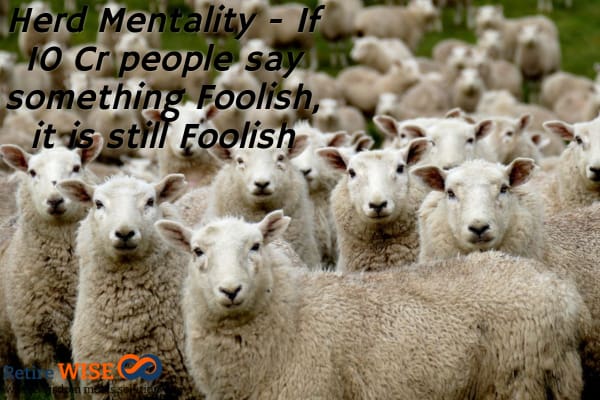
“If 10 crore people say something foolish, it is still foolish. The size of the herd does not determine the wisdom of the decision. In investing, the crowd is most united and most confident at exactly the wrong time – near the top.”
Why We Are Wired to Follow the Herd
Behavioural finance research has documented this bias extensively. The tendency to follow the group is partly evolutionary – in a hunter-gatherer environment, doing what your group did was genuinely safer than being different. The person who ran when the herd ran survived more often than the person who stood still to think independently.
Two cognitive biases drive herd behaviour in markets. The first is social proof – the tendency to look at what others are doing as evidence of the correct course of action. The second is FOMO (fear of missing out) – the specific pain of watching others profit from something you are not in.
FOMO is particularly powerful in investing because it involves visible, quantifiable loss. When your colleague tells you his small-cap fund is up 60% and your portfolio is up 15%, the gap is measurable. The pain of that gap often overrides the rational recognition that his 60% gain came from a category you deliberately did not overweight because it did not fit your risk profile.
How It Shows Up in Indian Markets (2020-2025)
The most recent cycle produced textbook examples of herd behaviour at every stage.
During the COVID crash of March 2020, retail investors redeemed aggressively from equity mutual funds. Herd behaviour drove selling at the bottom. Those who stayed invested recovered fully within a year.
In 2021, international fund inflows surged as US tech delivered exceptional returns. Investors poured money in near the peak. US tech subsequently fell 30 to 40% and international fund NAVs followed. Most of those investors are still underwater relative to their entry points.
In 2023 and early 2024, PSU funds and small/mid-cap funds were the talk of every WhatsApp group. SIP inflows into these categories multiplied. By mid-2024, SEBI had flagged frothy valuations. The correction arrived on schedule.
In 2024 and 2025, crypto enthusiasm returned. Bitcoin, Ethereum, and a range of altcoins attracted retail Indian investors who had been burned in 2022 but were drawn back by the visible gains of early movers.
The pattern is identical in every cycle: outsized past returns attract attention, attention attracts capital, capital inflows drive prices higher, higher prices attract more attention, and eventually the cycle reverses with most retail money near the top.
The Timing Problem
When you follow the herd, you are almost always late. The herd becomes visible and compelling only after a category has already delivered significant returns. By the time your neighbour is telling you about his gains, the professional money has been in for 12 to 18 months and is already thinking about when to reduce exposure. You are the last buyer. The herd is never visible at the beginning of a good investment – only near the end of it.
The Cost: Why You Always Buy Late and Sell Late
The structural problem with herd investing is that it systematically produces the worst possible entry and exit timing. You buy near the top because that is when the herd is most visible and most convincing. You sell near the bottom because that is when fear is most widespread and the herd is fleeing.
DALBAR’s annual Quantitative Analysis of Investor Behaviour consistently shows that average investors significantly underperform the market indices they are invested in. The gap is not fees or tax. It is timing – buying and selling at the wrong moments driven by herd behaviour and emotional reactions.
For a retirement investor, this timing gap compounds over decades. An investor who matches the index for 25 years builds significantly more wealth than one who underperforms by 3% annually due to poor timing. At retirement, the difference can be measured in crores.
It Is Not Just About Stocks
Herd mentality drives poor decisions across every financial category. Real estate has seen it repeatedly – periods where “everyone knows” that property prices only go up, followed by multi-year stagnation in cities like Noida, Gurgaon, and peripheral Mumbai where prices did not meaningfully recover for 8 to 10 years after the 2010-2012 peak.
Insurance-as-investment products were sold en masse for decades because “everyone was buying” ULIPs and endowment plans. Gold saw a speculative rush in 2010-2012. Crypto in 2021. NFOs in every bull market. The category changes; the herd behaviour is identical.
How to Protect Yourself
The single most effective protection is a written financial plan with a defined asset allocation. When your plan says 60% equity, 30% debt, 10% gold, and the small-cap frenzy is making you want to put 80% in equity, you have a prior calm decision to compare against. The plan is your anchor.
Add a 30-day rule to any investment impulse you can trace to something you saw others doing or heard about in a WhatsApp group. Write down the rationale today. Review it in 30 days. Most herd impulses do not survive 30 days of reflection.
Rebalance to your target allocation annually rather than chasing what worked last year. This automatically forces you to sell what has risen (and is now overweight) and buy what has lagged (and is now underweight) – the opposite of what the herd is doing.
For more on managing behavioural biases in investing, see our article on why too much financial news hurts your investment decisions.
A Plan That Holds When the Herd Is Loudest
RetireWise builds retirement portfolios anchored in a written plan with clear asset allocation – designed to hold through market cycles and resist the pull of herd behaviour. Explore how we approach retirement planning.
Frequently Asked Questions
Is following the herd always wrong in investing?
Not always. Sometimes the herd is right and early. The problem is that by the time the herd is visible enough to follow, the risk-reward for late followers is usually poor. The herd that moves first into an undervalued category makes the returns. The herd that arrives after the headlines are written absorbs the downside. The safest assumption is that if something is on every WhatsApp group and every finfluencer is talking about it, the best entry point has already passed.
How do I distinguish between a good investment and herd-driven enthusiasm?
A genuine investment case answers: does this fit my financial plan, risk profile, and goals? What is the valuation relative to history? What has driven recent returns – fundamental improvement or multiple expansion? Am I drawn to this because I’ve done the analysis or because I’ve seen others profit? If the primary reason is the latter, it is herd behaviour, not investment analysis.
How do I explain to friends and family why I am not investing in what everyone else is?
You do not need to justify it in the moment. The standard answer: “I have a financial plan and a fixed asset allocation. I only change my portfolio when my plan says to, not when the market moves.” Most people cannot argue with this. If they push, note that you will revisit it in your next annual review. Then do not revisit it unless your plan genuinely calls for it.
What is the best way to handle FOMO when markets are rallying strongly?
Have a pre-committed answer ready before the FOMO arrives. Write it down now: “When small-caps are up 60% and I feel I am missing out, I will not change my SIP allocation for 30 days and will call my advisor before doing anything.” Having a pre-written rule removes the need for in-the-moment willpower. Willpower runs out; rules do not.
Before You Go
Related reading: 10 Investment Mistakes That Cost Indian Investors Lakhs and The Sunk Cost Fallacy: Why You Are Holding Bad Investments Longer Than You Should.
Have you made an investment decision driven by herd behaviour? Looking back, what would you have done differently? Share in the comments.
One question for you: Think of your last three investment decisions. How many were driven by something you saw others doing or heard about – and how many came from your own financial plan?
Thought provoking article, made my day.
I also advocate the same to my friends and my audience on my blog
TFL is doing a great job. Keep it up
One should not blindly follow the “herd mentality”. One should seriously analyse the market and then come to a conclusion regarding the stocks. One should buy it when the prices are low so that one may sell it at an appropriate price later. One should study the market conditions daily and in a systematic manner. It comew with knowledge and experience.
Dear Subra,
I am not sure if daily analysing the market will help but people should write their investment principles & stick to them – whatever the market situation is.
Hi Hemant
I suffered from herd mentality around 15 years back when I purchased some shares and mutual funds based on the advice of some friends but after following TFL I have not done that mistake.
Thanks Anil Ji for appreciating & always encouraging us 🙂
Herd metality is our inherited eroded culture / liablity. Ceturies of misrule by foreigners have muted our skill of intelligency and independent thinking . Why ,we have the best tool of self governance – The Democracy – even there, we are victim of Herd Mentality, we vote because we have the Right ( minus responsiblity) to Vote, Vote a cndidate because others say `He is Good’ ,the candiadte himself does some cheap marketing gimmics , thrives on Brand Image ,maneuvers our mentality and succeeds in misselling himself like a benefactor . There has to be constant vigil and awakening.
You are doing your bit well , in Financial litracy .My compliments.
Dear Hari,
I agree Herd Mentality works in politics but I am not sure if centuries of misrule is the only reason.
Herd mentality was seen in the IPO of reliance power, gold & real estate etc. I know many people who have a victim of this. This phenomena must be crushed. One must do one’s own due diligence.
Yes Rajiv – Reliance Power is the best example of Herd Mentality that we witnessed in Indian Financial Markets. This may surprise many that even today number of shareholder in Reliance Power (36 Lakh) is more than number of shareholder in Reliance Industries (26 Lakh) 🙁
Thanks 4 the shareholder ‘s nos.
Comments are closed.